Drain field repair in Raleigh and Wake County
Quick answer: The drain field (drain lines in the soil) is where wastewater from the tank actually soaks in and gets treated. When it fails, water has nowhere to go: you see soggy ground, odor, or backups even after the tank is pumped. In Wake County, repairing or relocating drain lines is a “repair” that needs a county permit.
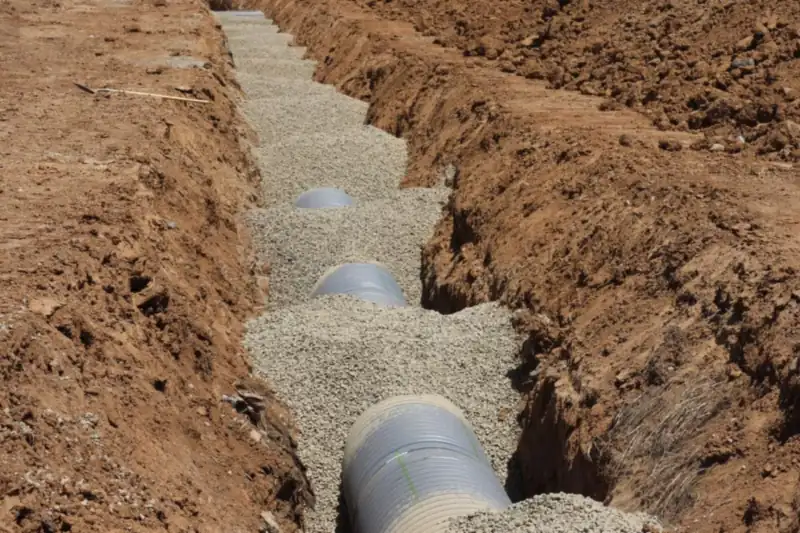
Why drain fields fail
Solids carried out of the tank
When a tank is not pumped often enough or a baffle fails, solids move into the lines and clog the soil.
Too much water
The EPA lists excess water use as a common cause — big laundry days, leaks, and running toilets all overload the field.
Damage on the surface
Driving or parking over the field, building over it, or planting trees nearby can crush lines or let roots in.
Age
Wake County notes that on-site systems have a limited lifespan, though properly maintained systems can last 25 years or more.
Source: US EPA — Resolving Septic System Malfunctions; US EPA — How to Care for Your Septic System; Wake County — Septic Maintenance and Repairs; Wake County news release, Aug 21, 2023, retrieved 2026-11-17.
How a drain field repair works in Wake County
Diagnose
Pump and inspect the tank, check baffles and the distribution box, and look at where the field is failing. A drain field problem can start in the tank.
Apply for the repair permit
Wake County takes repair requests online through its permit portal as a “Permit for Wastewater Repair (Septic).” Questions: 919-856-5700.
County evaluation and design
The county reviews the site and the repair. Under North Carolina’s 15A NCAC 18E rules, the repair has to fit the soil and site.
Install and inspect
New or relocated lines go in according to the permit, and the work is inspected.
Wake County also says that when a repair system is installed, the old drain field area is reserved for future repair and the system is considered “on rest.” Expect the yard layout around the system to matter.
Source: Wake County — Septic Maintenance and Repairs; NCDHHS — On-Site Wastewater Laws and Rules (15A NCAC 18E), retrieved 2026-11-17.
Things that affect a drain field repair (not a price)
- How much usable soil is left on the lot, and where the old field sits
- Whether a pump or a different system type is needed to reach a suitable area
- Distance from a private well: state rules set 100 feet between a well and a septic system, which can be reduced to 50 feet for a single-family home’s well when the lot does not allow 100
- Access for equipment, driveways, and anything built near the field
Source: NCDHHS — Private Wells FAQ (PDF), retrieved 2026-11-17.
Have a pumping report or a county letter? Send it with your request.
Request a quoteDrain field FAQ
Can a drain field be repaired, or does it have to be replaced?
Sometimes a damaged section or a failed distribution box can be fixed. When the soil itself is clogged, the usual answer is new lines in a different area, under a county repair permit.
Will additives fix a failing drain field?
Additives are not a substitute for repair. The EPA’s guidance focuses on regular inspection and pumping, careful water use, and keeping solids, grease, and wipes out of the system.
Can I keep using water while I wait?
Cut use as much as you can: spread out laundry, fix leaks, and avoid long showers. Less water entering the system slows the symptoms.